

- HOME
- Useful Info
- Valve Selection Guide: How to Choose the Right Soft Seats for Your Valves
Valve Selection Guide: How to Choose the Right Soft Seats for Your Valves
In ball valve applications, sealing performance plays a critical role in ensuring reliable and stable system operation. When operating conditions demand corrosion resistance, tight shut-off performance, and long-term sealing reliability, selecting the right soft seat material is essential.
Soft-seated ball valves are widely used across industries due to their ability to provide excellent sealing performance, including bubble-tight shut-off under specified operating and testing conditions.
However, with a wide variety of seat materials available, how do you choose the most suitable option while balancing sealing performance, durability, and cost-effectiveness?
In this article, we explore the most commonly used ball valve seat materials, their characteristics, and their recommended applications to help you make an informed decision.
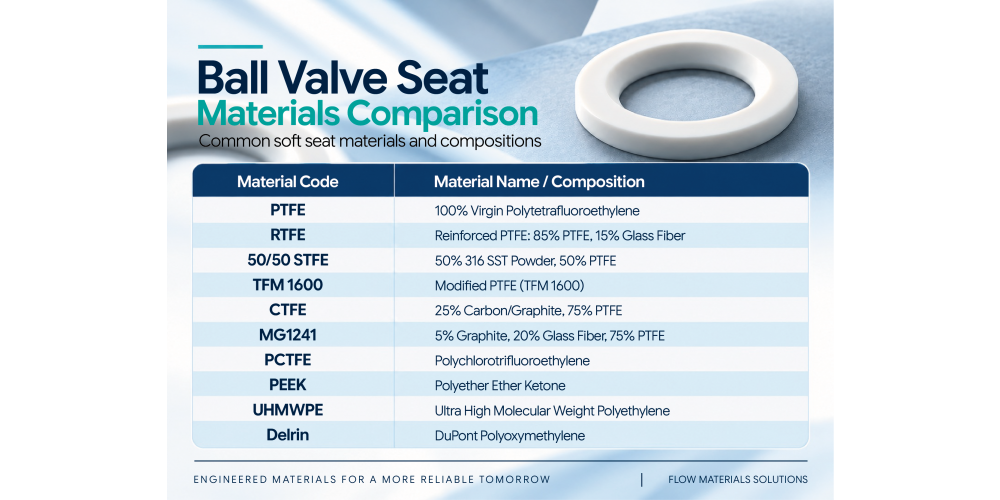
Common Ball Valve Seat Materials and Compositions
Let's take a closer look at the most commonly used ball valve seat materials and their compositions.
|
Material Code |
Material Name / Composition |
|---|---|
|
PTFE |
100% Virgin Polytetrafluoroethylene |
|
RTFE |
Reinforced PTFE: 85% PTFE + 15% Glass Fiber |
|
50/50 STFE |
50% 316 Stainless Steel Powder + 50% PTFE |
|
TFM 1600 |
Modified PTFE (TFM 1600) |
|
CTFE |
Carbon/Graphite-Filled PTFE: 75% PTFE + 25% Carbon/Graphite* |
|
MG1241 |
75% PTFE + 20% Glass Fiber + 5% Graphite |
|
PCTFE |
Polychlorotrifluoroethylene |
|
PEEK |
Polyether Ether Ketone |
|
UHMWPE |
Ultra-High Molecular Weight Polyethylene |
|
Delrin |
Polyoxymethylene (POM / Acetal) |
Note: CTFE is used here as a supplier-specific designation for carbon/graphite-filled PTFE. The material code and composition should be confirmed against the applicable supplier specifications before publication.
Understanding the Characteristics and Applications of Soft Seat Materials
1. Polytetrafluoroethylene (PTFE / Virgin PTFE)
Material Properties:
PTFE offers excellent chemical resistance and a very low coefficient of friction, helping reduce valve operating torque while providing reliable sealing performance.
Its excellent chemical inertness makes it suitable for a broad range of industrial applications.
Recommended Applications:
- General water and air services
- Mild acids and alkalis
- A wide range of compatible chemical media
2. Reinforced Polytetrafluoroethylene (RPTFE / Reinforced PTFE)
Material Properties:
Reinforced PTFE contains fillers such as glass fiber or carbon fiber to improve compressive strength, wear resistance, and dimensional stability compared to virgin PTFE.
The type and percentage of reinforcement vary depending on the specific material grade.
Recommended Applications:
- Hot water systems
- Certain steam services within the material's rated limits
- Compatible organic solvents
- Industrial applications requiring improved wear resistance and mechanical strength
3. Ultra-High Molecular Weight Polyethylene (UHMWPE)
Material Properties:
UHMWPE offers exceptional toughness, excellent abrasion resistance, and good impact resistance. Certain grades also provide useful radiation resistance.
Its durability makes it suitable for applications involving abrasive media or repeated mechanical stress.
Recommended Applications:
- Fluids containing fine suspended particles
- Selected slurry applications
- Certain specialty chemical services, including oxalic acid where compatibility is verified
4. Polyether Ether Ketone (PEEK)
Material Properties:
PEEK is a high-performance engineering thermoplastic known for its outstanding mechanical strength, wear resistance, and high-temperature capability.
Compared with conventional PTFE, PEEK generally offers greater structural rigidity and resistance to deformation under load.
Recommended Applications:
- High-pressure industrial systems
- High-temperature oil services
- Selected steam applications within specified design limits
- Demanding offshore and industrial applications
Chemical compatibility and sealing performance should be evaluated for the specific fluid, temperature, and pressure conditions.
5. High-Performance Polyamide (Devlon)
Material Properties:
Devlon is a high-performance polyamide material developed for demanding mechanical applications. It offers high strength, impact resistance, and resistance to deformation under pressure.
Its properties make it a suitable option for certain high-pressure valve seat applications.
Recommended Applications:
- High-pressure natural gas pipelines
- High-pressure water systems
- Selected hydraulic and industrial fluid control applications
Selecting the Right Ball Valve Seat Material
Choosing the most suitable seat material requires more than comparing individual material properties.
Several operating factors should be considered, including:
- Fluid Compatibility: The seat material must be chemically compatible with the process media.
- Operating Temperature: Continuous and peak temperatures must remain within the material and valve assembly's rated limits.
- Operating Pressure: Pressure differential, temperature, and potential seat deformation must be evaluated together.
- Sealing Requirements: Required leakage performance should be defined by the applicable test standard and operating conditions.
- Wear Resistance and Service Life: Operating frequency, abrasive particles, and mechanical loading can influence long-term performance.
- Cost-Effectiveness: Material selection should balance initial cost, maintenance requirements, and expected service life.
Selecting the appropriate material helps improve valve reliability, reduce maintenance requirements, and support efficient long-term operation.
TAWD Engineering Team — Your Trusted Partner in Valve Seat Selection
Not sure which soft seat material is right for your application?
TAWD’s experienced engineering team provides expert technical guidance and material selection recommendations. From complex process media and extreme temperatures to demanding high-pressure applications, we help you find the most suitable, reliable, and cost-effective sealing solution.
👉 Contact the TAWD Engineering Team today and let us help you find the right sealing solution for your application!